

What is Perfume Longevity? Understanding Its Importance
Perfume longevity is more than just a matter of fancy packaging or high price tags. Some parfum concentrations can last up to 8 hours or more, while others fade in less than two. Most people think buying the most expensive bottle guarantees a scent that lingers all day. The truth is, the secret lies in skin chemistry, concentration, and even how you apply each spritz.
Table of Contents
- Defining Perfume Longevity: Basic Concepts
- The Importance of Longevity in Fragrance Selection
- Factors Influencing Perfume Longevity
- Common Myths About Perfume Longevity
- How to Assess Longevity in Your Favourite Scents
Quick Summary
| Takeaway | Explanation |
|---|---|
| Fragrance concentration affects longevity. | Higher concentrations like Parfum last longer than lighter versions like Eau de Cologne. |
| Skin chemistry impacts scent duration. | Drier skin typically results in shorter fragrance longevity compared to well-moisturised skin. |
| Application technique matters for performance. | Applying perfume to pulse points enhances projection and longevity due to heat and circulation. |
| Longevity influences economic value. | Longer-lasting perfumes reduce reapplication frequency and provide better cost-effectiveness over time. |
| Debunk common longevity myths. | Price does not guarantee longevity; focus on concentration and application techniques instead. |
Defining Perfume Longevity: Basic Concepts
Perfume longevity represents the duration a fragrance remains detectable and pleasant on an individual’s skin after initial application. Understanding this fundamental aspect of fragrances helps consumers make informed purchasing decisions and select scents matching their specific lifestyle and preferences.
The Science Behind Scent Duration
At its core, perfume longevity depends on multiple interconnected factors. Fragrance concentration plays a critical role in determining how long a scent will persist. Perfumes are typically categorised into different strength levels, each with distinct staying power:
Below is a comparison table outlining the different fragrance concentration types and their respective aromatic compound percentages and typical longevity, providing clarity on how each option performs.
| Concentration Type | Aromatic Compound (%) | Typical Longevity (Hours) |
|---|---|---|
| Parfum/Extrait de Parfum | 20-40 | 6-8 |
| Eau de Parfum | 15-20 | 4-5 |
| Eau de Toilette | 5-15 | 2-3 |
| Eau de Cologne | 2-4 | 1-2 |
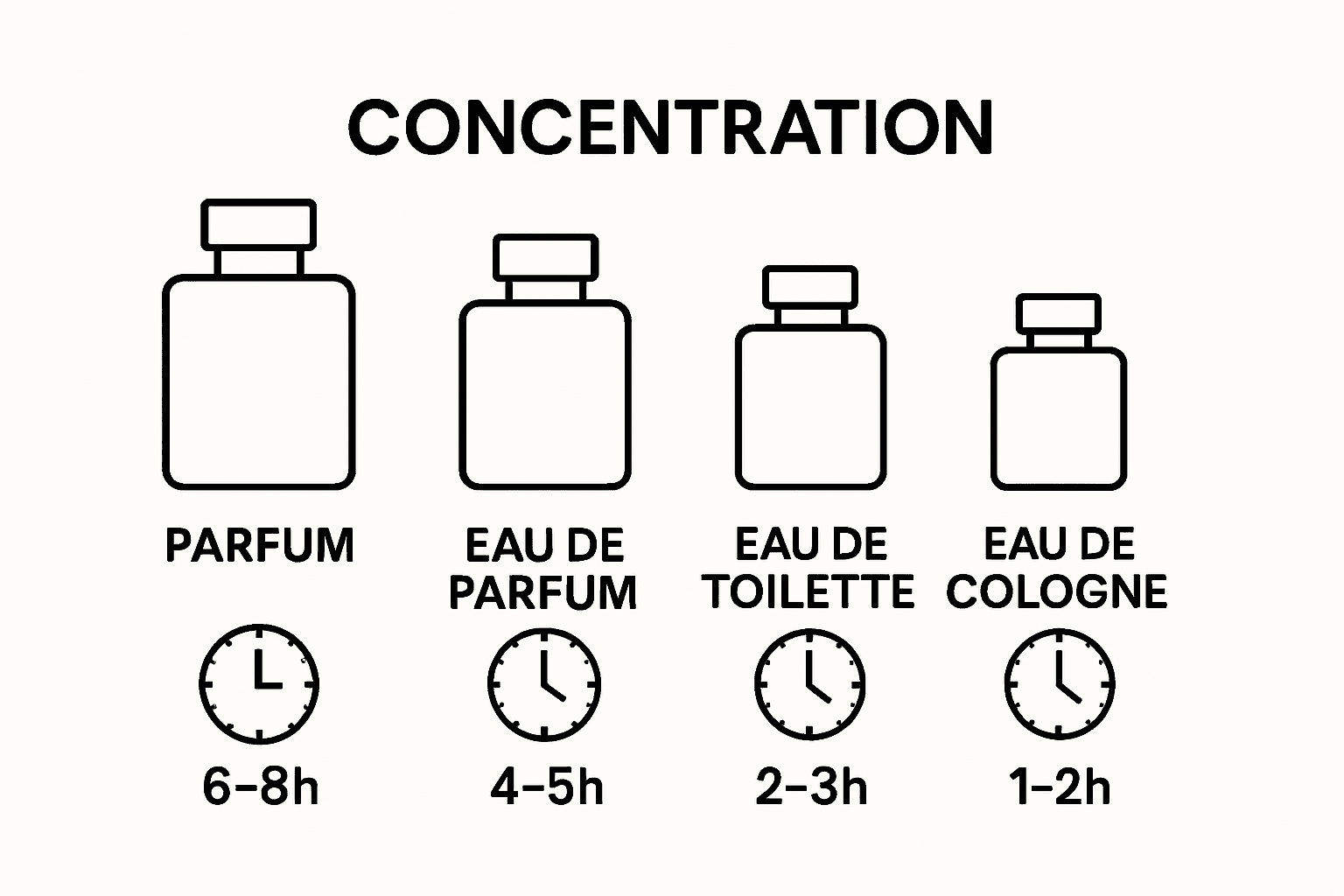
- Parfum/Extrait de Parfum: Highest concentration (20-40% aromatic compounds), lasting 6-8 hours
- Eau de Parfum: Moderate concentration (15-20% aromatic compounds), lasting 4-5 hours
- Eau de Toilette: Lower concentration (5-15% aromatic compounds), lasting 2-3 hours
- Eau de Cologne: Lightest concentration (2-4% aromatic compounds), lasting 1-2 hours
Factors Influencing Fragrance Persistence
Multiple variables affect how long a perfume remains noticeable. Skin chemistry, environmental temperature, humidity levels, and individual body heat significantly impact scent projection and duration. Individuals with drier skin typically experience shorter fragrance longevity compared to those with more moisturised skin.
For fragrance enthusiasts seeking longer-lasting scents, understanding these nuanced characteristics becomes paramount. Selecting high-quality perfumes with appropriate concentrations and understanding personal skin interactions can dramatically enhance one’s fragrance experience.
The Importance of Longevity in Fragrance Selection
Fragrance longevity serves as a crucial consideration for consumers when selecting perfumes, transforming a simple purchase into a strategic investment in personal style and sensory experience. Understanding how long a scent persists can significantly impact both practical usage and overall satisfaction with a fragrance.
Economic and Practical Considerations
Longevity directly influences the economic value of a perfume. Longer-lasting fragrances provide more efficient use, reducing the frequency of reapplication and ultimately delivering better value for money. Consumer research indicates that individuals prioritise perfumes offering extended wear time, viewing them as more cost-effective and convenient.
Key economic advantages of long-lasting fragrances include:
- Fewer applications required per day
- Reduced overall product consumption
- Better price-per-wear value
- Minimised need for carrying additional perfume bottles
Psychological and Social Dimensions
Perfume longevity extends beyond mere practicality, touching deeper psychological and social dimensions of personal presentation. A fragrance that maintains its character throughout the day communicates confidence, sophistication, and meticulous personal grooming. Heat-proof scent selection becomes particularly important in challenging environmental conditions, ensuring consistent olfactory presence.
Beyond personal satisfaction, long-lasting fragrances create memorable sensory impressions in social interactions. The ability of a scent to persist subtly throughout various activities signals quality and thoughtfulness in personal styling, making longevity a critical factor for discerning fragrance enthusiasts.
Factors Influencing Perfume Longevity
Perfume longevity is a complex interplay of multiple environmental, physiological, and chemical factors that determine how effectively a fragrance remains perceptible after application. Understanding these intricate elements can help fragrance enthusiasts optimise their scent experience and make more informed purchasing decisions.
The following table summarises key physiological and environmental factors that influence how long a perfume lasts on the skin, helping readers better understand the variables affecting scent longevity.
| Factor | Impact on Longevity | Details/Notes |
|---|---|---|
| Skin pH levels | Alters scent development and persistence | Can change how molecules interact with the skin |
| Skin moisture | Extends longevity | Hydrated skin helps retain fragrance molecules |
| Body temperature | Affects scent evaporation rate | Warmer bodies accelerate evaporation |
| Sebum production | Can improve longevity | Oily skin holds fragrance longer |
| Environmental temperature | Higher temperature reduces longevity | Scent evaporates faster in heat |
| Humidity | Variable effect | May either enhance or diminish projection |
| Application technique | Optimises performance | Pulse points and storage are key considerations |
Physiological and Skin-Related Factors
Scientific research reveals that individual physiological characteristics significantly impact fragrance persistence. Skin type, moisture levels, and personal body chemistry play crucial roles in how a perfume develops and maintains its olfactory profile. Key physiological factors include:
- Skin pH levels: Influences how fragrance molecules interact with skin
- Skin moisture: Hydrated skin helps fragrances bind more effectively
- Body temperature: Higher temperatures accelerate scent evaporation
- Sebum production: Oily skin can help fragrances last longer
Environmental and Application Considerations
External conditions dramatically affect perfume longevity. Temperature, humidity, and application technique can transform a fragrance’s performance. Warmer environments typically cause faster scent evaporation, while cooler conditions help preserve the fragrance’s molecular structure.
Application strategies also critically influence longevity. Pulse points like wrists, neck, and behind ears provide optimal heat and blood circulation for fragrance projection. Proper perfume storage further ensures the preservation of a fragrance’s molecular integrity, protecting its essential aromatic compounds from degradation.
Fragrance composition itself remains a fundamental determinant of longevity. Perfumes containing heavier base notes like woody, musky, or oriental elements typically demonstrate superior staying power compared to lighter, more volatile citrus or floral compositions.
Common Myths About Perfume Longevity
Perfume enthusiasts often encounter numerous misconceptions regarding fragrance persistence, which can lead to unrealistic expectations and suboptimal purchasing decisions. Debunking these myths requires a nuanced understanding of fragrance chemistry and individual sensory experiences.
Price and Quality Misconceptions
Consumer research challenges the widespread belief that expensive perfumes automatically guarantee superior longevity. Contrary to popular assumption, price does not directly correlate with a fragrance’s staying power. Concentration and molecular composition matter significantly more than brand prestige or cost.
Common pricing myths include:
- Luxury brands always provide longer-lasting fragrances
- Higher price automatically indicates better performance
- Designer perfumes universally outperform more affordable alternatives
- Expensive packaging guarantees superior scent retention
Application and Storage Misunderstandings
Numerous myths surround perfume application techniques and storage practices. Many individuals believe rubbing wrists together after spraying enhances fragrance performance, when in fact, this action can break down molecular structures and reduce longevity. Similarly, storing perfumes in bathroom cabinets or areas with temperature fluctuations can significantly degrade their chemical composition.
Additionally, understanding luxury fragrance nuances helps consumers make more informed choices. The persistent myth that more sprays automatically translate to longer-lasting scents is fundamentally flawed. Strategic, targeted application on pulse points proves far more effective than excessive spraying.
Understanding these myths empowers fragrance enthusiasts to make more sophisticated, scientifically informed choices about perfume selection and usage.
How to Assess Longevity in Your Favourite Scents
Evaluating perfume longevity requires a systematic approach that combines personal experience, scientific understanding, and strategic assessment techniques. Fragrance enthusiasts can develop nuanced methods to accurately gauge a scent’s performance and persistence.
Professional and Personal Evaluation Techniques
Fragrance documentation reveals multiple strategies for assessing perfume longevity. Experienced enthusiasts employ comprehensive approaches that go beyond casual observations, creating structured frameworks for measuring scent performance.
Key evaluation methods include:
- Tracking actual wear time with precise timekeeping
- Noting scent progression through different stages
- Comparing performance across various environmental conditions
- Recording subjective impressions at regular intervals
Sensory Assessment Strategies
Molecular complexity plays a crucial role in determining how long a fragrance remains perceptible. Evaluating longevity involves understanding how different fragrance notes interact and decompose over time. Base notes typically provide the most extended olfactory experience, with woody, musky, and oriental compositions demonstrating superior staying power.
Identifying quality perfume requires keen sensory perception. Enthusiasts should pay attention to:
- Initial projection strength
- Gradual scent transformation
- Subtle remaining traces after extended wear
- Consistency across multiple applications
Understanding these nuanced assessment techniques empowers fragrance lovers to make more informed purchasing decisions and develop a deeper appreciation for the complex world of perfumery.

Discover Perfume Longevity That Lasts with Alexandria UK
Have you ever chosen a beautiful fragrance only to be disappointed as the scent fades after just a few hours? Many perfume lovers struggle with finding long-lasting fragrances that truly reflect their style and last throughout busy days. Our article explored the science of perfume longevity and why choosing a scent that endures is vital for both confidence and value for money. If you are searching for outstanding perfumes inspired by iconic scents, but with superior persistence and unmatched quality, you have come to the right place.
Experience the difference today. Visit Alexandria UK to browse our expertly crafted collection of perfumes and dupes, each designed with powerful longevity in mind. Want to go deeper? Discover how we ensure premium durability in every bottle by reading more in our Fragrance Academy and learn how to get the most out of your scent with our tips on storing your perfumes. Do not settle for fleeting fragrances. Choose a scent that stays with you, and experience the confidence of all-day allure now.
Frequently Asked Questions
What is perfume longevity?
Perfume longevity refers to the duration that a fragrance remains detectable and pleasant on the skin after it has been applied.
What factors influence how long a perfume lasts?
Multiple factors affect perfume longevity, including fragrance concentration, body chemistry, skin type, moisture levels, environmental conditions, and application methods.
How can I make my perfume last longer?
To enhance perfume longevity, apply it to pulse points such as the wrists and neck, ensure your skin is moisturised, store your fragrances properly away from heat and light, and choose higher concentration perfumes.
Do more expensive perfumes always last longer?
Not necessarily. The price of a perfume does not always correlate with its longevity. Factors like concentration and molecular composition are more significant in determining how long a scent lasts than brand prestige or cost.
Recommended
- Understanding What Perfume Lasts the Longest
- What is the Most Expensive Perfume? Understanding Luxury Fragrance
- How to Identify Quality Perfume: A Step-by-Step Guide
- Understanding Why Perfume is Expensive and Its Value
- Top Benefits of Aromatherapy in Skincare for Glowing Skin
- AROMAS ENCAPSULADOS - kolorguide


