



Understanding the Types of Fragrance Notes in Perfume
Fragrance notes are the secret language behind every memorable perfume, shaping the way we experience our favourite scents. Think you know what makes a fragrance stand out? Over 75 percent of a perfume’s lasting impression comes from the way its notes are layered and structured. Most people focus on the bottle or the brand, but it is the invisible dance of top, heart, and base notes that truly defines the art and science of perfumery.
Table of Contents
- What Are Fragrance Notes? An Overview
- The Importance of Notes in Scent Composition
- Types of Fragrance Notes: Top, Middle, and Base
- How Fragrance Notes Influence Scent Perception
- Real-World Applications of Fragrance Notes in Perfumes
Quick Summary
| Takeaway | Explanation |
|---|---|
| Fragrance notes define scent complexity | Each note contributes to the overall scent, creating a multifaceted experience. Understanding them enhances appreciation for perfumes. |
| Top, heart, and base notes serve distinct roles | These three layers interact uniquely, dictating how a fragrance evolves from application to lasting impression. |
| Personal fragrance reflects identity | Choosing scents allows individuals to express personality and emotions, serving as a non-verbal communication tool. |
| Fragrance notes influence psychological responses | Scent can trigger memories and emotions, making it a powerful element in personal and therapeutic contexts. |
| Fragrance composition blends art and science | Creating perfumes requires both scientific expertise and creative intuition to harmonise different notes effectively. |
What Are Fragrance Notes? An Overview
Fragrance notes represent the individual scent components that collectively create a perfume’s complete olfactory profile. Think of them like musical notes in a symphony, where each element contributes to the overall sensory experience. Understanding these notes helps perfume enthusiasts appreciate the complexity and artistry behind their favourite fragrances.
The Fundamental Structure of Fragrance Notes
Fragrance notes are typically categorised into three primary layers: top notes, heart notes, and base notes. Explore our comprehensive guide on fragrance composition to understand how these layers interact and create a harmonious scent.
Each layer plays a specific role in the perfume’s development:
- Top Notes: The initial scent perceived immediately after application, typically light and volatile
- Heart Notes: The core essence that emerges after top notes dissipate, representing the perfume’s primary character
- Base Notes: The foundational scents that provide depth and longevity, lingering longest on the skin
Understanding Fragrance Note Complexity
Perfumers meticulously select and blend fragrance notes to create unique sensory experiences. These notes can be derived from natural sources like flowers, fruits, woods, and spices, or crafted using synthetic aromatic compounds. According to expert perfume research, modern fragrances often combine both natural and synthetic ingredients to achieve nuanced and long-lasting scent profiles.
The interaction between different fragrance notes creates a dynamic olfactory journey. When you first spray a perfume, the top notes provide an immediate, often bright and fresh impression. As these lighter molecules evaporate, the heart notes emerge, revealing the perfume’s true character. Finally, the base notes establish a rich, enduring foundation that can persist for hours after application.
By understanding fragrance notes, you gain insight into the intricate art of perfumery and can better appreciate the skill required to compose a memorable scent.
The Importance of Notes in Scent Composition
Fragrance notes are far more than simple aromatic ingredients. They represent a sophisticated architectural approach to perfume design, where each element serves a strategic purpose in creating a complete sensory narrative. Learn about advanced scent layering techniques to understand how professional perfumers craft complex olfactory experiences.
The Narrative Architecture of Fragrance
Perfumers approach scent composition like master storytellers, using notes to craft an emotional journey. Each fragrance note contributes a specific narrative element, transforming a simple mixture of ingredients into a compelling sensory experience. The interaction between notes creates depth, complexity, and emotional resonance.
The composition process involves intricate considerations:
- Balancing volatile and persistent aromatic compounds
- Creating harmonious transitions between different note layers
- Ensuring consistent performance and emotional impact
Scientific and Artistic Dimensions of Note Selection
Choosing fragrance notes requires both scientific precision and artistic intuition. According to fragrance research from the Fragrance Foundation, professional perfumers spend years developing expertise in understanding molecular interactions, botanical extracts, and sensory perception.
The scientific approach involves:
- Analyzing chemical structures of aromatic compounds
- Understanding molecular volatility and evaporation rates
- Predicting how different ingredients will interact over time
From an artistic perspective, fragrance notes are like musical instruments in an orchestra. Each note has a unique character, emotional resonance, and temporal presence. Some notes provide immediate brightness, while others create a lingering, contemplative backdrop. The perfumer’s skill lies in orchestrating these elements into a cohesive, memorable composition that evokes specific emotions and memories.
By understanding the intricate relationship between fragrance notes, enthusiasts can appreciate perfumery as a nuanced art form that bridges chemistry, creativity, and human sensory experience.
Types of Fragrance Notes: Top, Middle, and Base
Fragrance notes operate like a carefully choreographed performance, with each layer playing a distinct role in creating a memorable olfactory experience. Unlock the secrets of fragrance composition to understand how these intricate layers work together.
Top Notes: The Initial Impression
Top notes are the first encounter in a fragrance’s sensory journey, providing an immediate and often vibrant introduction. These volatile aromatic compounds evaporate quickly, typically lasting 10-15 minutes after application. Perfumers strategically select top notes to create an initial attraction and entice the wearer.
Common top note characteristics include:
- Light, fresh, and energetic scents
- Typically derived from citrus, herbal, or light fruity essences
- Designed to create an immediate sensory impact
Middle Notes: The Heart of the Fragrance
Also known as heart notes, these emerge once the top notes dissipate, representing the core character of the perfume. Middle notes typically last 3-5 hours and form the fragrance’s primary emotional narrative. They bridge the gap between the initial brightness of top notes and the deep, lasting essence of base notes.
Typical middle note elements include:
- Floral, spicy, or rounded fruity scents
- More complex and nuanced aromatic profiles
- Responsible for creating the fragrance’s primary emotional resonance
Base Notes: The Enduring Foundation
Base notes are the longest-lasting components, providing depth and longevity to the fragrance.
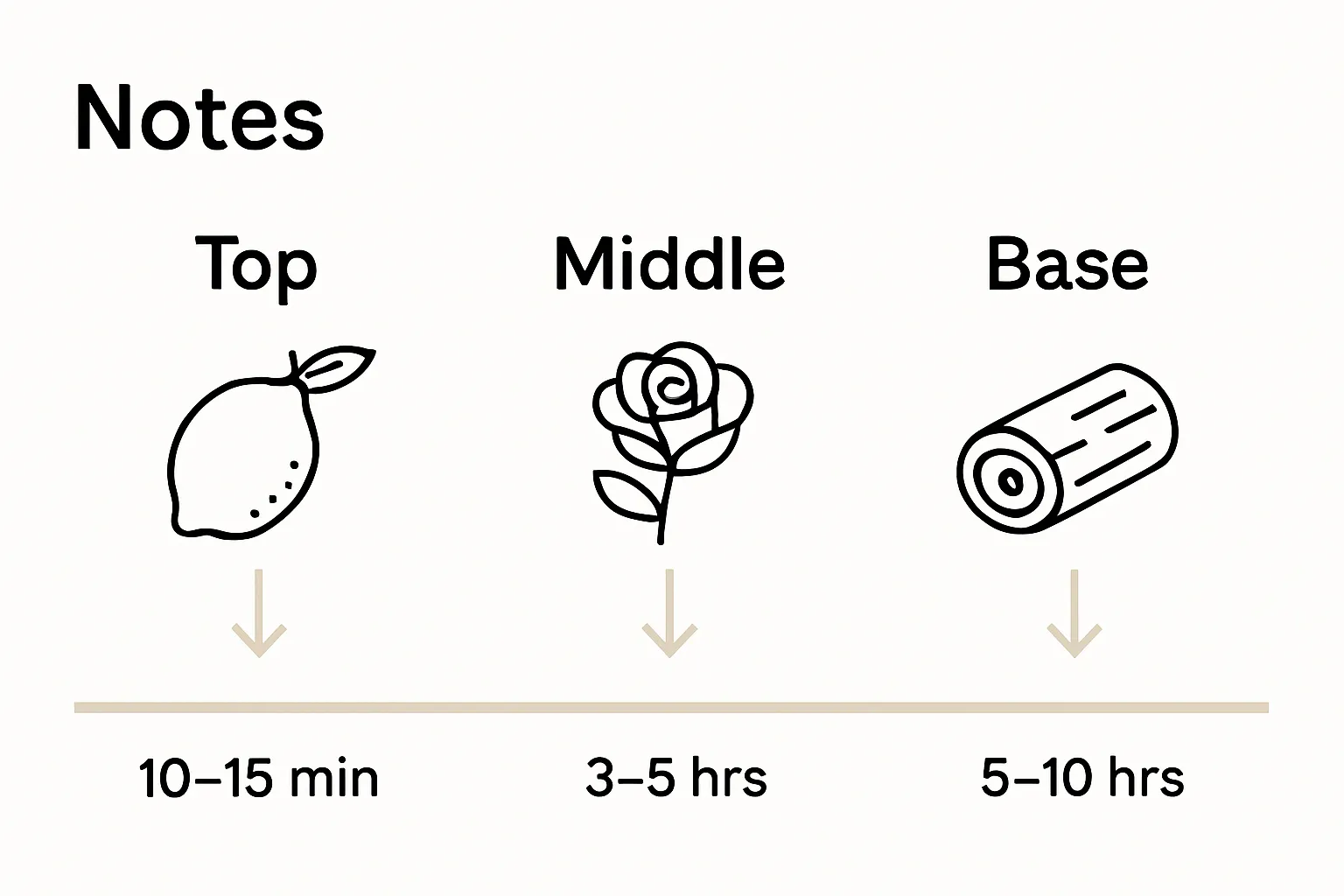 According to aromatic research from the Perfumer’s Workbook, base notes can persist on the skin for 5-10 hours, creating a memorable olfactory signature.
Characteristics of base notes include:
- Rich, deep, and often woody or musky scents
- Molecules with higher molecular weight and slower evaporation rates
- Provide complexity and lasting impression to the overall fragrance composition
Understanding these note types reveals the intricate artistry behind perfume creation. Each layer contributes uniquely to the sensory experience, transforming a simple mixture of ingredients into a complex, emotionally evocative composition.
To clarify the different roles of top, middle, and base notes in perfume, the following table compares their characteristics, longevity, scent qualities, and typical ingredients.
| Note Type | Longevity on Skin | Scent Qualities | Typical Ingredients |
|---|---|---|---|
| Top Notes | 10-15 minutes | Light, fresh, energetic | Citrus, herbal, light fruity essences |
| Middle Notes | 3-5 hours | Floral, spicy, rounded | Jasmine, rose, cinnamon, soft fruits |
| Base Notes | 5-10 hours | Deep, rich, woody, musky | Sandalwood, vanilla, musk, patchouli |

How Fragrance Notes Influence Scent Perception
Fragrance notes are far more than mere chemical compounds. They represent a sophisticated psychological and neurological interaction that transforms simple scents into complex emotional experiences. Discover the art of personalised fragrance selection to understand how different notes impact individual perception.
Psychological Impact of Fragrance Notes
Our olfactory system is deeply connected to memory and emotion, making fragrance notes powerful triggers for psychological responses. Scent perception involves complex neurological pathways that link directly to the brain’s limbic system, responsible for processing emotions and memories.
Key psychological dimensions of fragrance notes include:
- Triggering specific emotional states
- Evoking personal and cultural memories
- Creating immediate sensory impressions
Neurological Processing of Aromatic Compounds
When fragrance notes interact with olfactory receptors, they initiate a complex sensory communication process. According to neuroscience research from Nature, different molecular structures stimulate specific neural pathways, generating unique perceptual experiences.
The neurological perception involves:
- Instant recognition of molecular structures
- Rapid transmission of sensory information
- Complex interpretation beyond simple chemical detection
Individual Variation in Scent Perception
Fragrance notes are experienced uniquely by each individual, influenced by genetic makeup, personal history, and physiological factors. Perfumers must consider these variations when creating complex scent compositions.
Factors affecting individual scent perception include:
- Genetic differences in olfactory receptor genes
- Personal emotional associations
- Physiological variations in sensory processing
Understanding how fragrance notes influence perception reveals the intricate relationship between chemistry, neurology, and human experience.
The table below summarises how fragrance notes influence psychological and sensory perception by listing the main psychological and neurological dimensions, as well as the factors behind individual variation.
| Influence Area | Description |
|---|---|
| Psychological Impact | Triggers emotions, memories, and creates immediate sensory impressions |
| Neurological Response | Activates limbic system, processes scent via neural pathways |
| Individual Variation | Shaped by genetics, personal history, and sensory processing |
Each note serves as a nuanced communication channel, transforming simple aromatic molecules into profound sensory narratives.
Real-World Applications of Fragrance Notes in Perfumes
Fragrance notes transcend theoretical concepts, playing crucial roles across multiple industries and personal experiences. Learn about advanced scent combination techniques to understand their practical applications.
Personal Fragrance and Identity
Fragrance notes serve as powerful tools for personal expression and identity creation. Individuals select perfumes that reflect their personality, mood, and social context. The strategic combination of notes allows people to communicate non-verbally through olfactory impressions.
Personal fragrance applications include:
- Creating professional and personal first impressions
- Expressing individual style and emotional state
- Enhancing personal confidence and self-perception
Commercial and Industrial Uses
Beyond personal perfumery, fragrance notes find extensive applications in diverse industries. According to research from the Fragrance Foundation, aromatic compounds play critical roles in product development and consumer engagement.
Industrial fragrance note applications encompass:
- Developing signature scents for brands
- Creating environmental atmospheres in retail spaces
- Designing therapeutic and wellness products
Psychological and Wellness Interventions
Fragrance notes are increasingly recognised for their potential psychological and therapeutic applications. Certain molecular combinations can influence mood, reduce stress, and trigger specific emotional responses.
Wellness-oriented fragrance applications include:
- Aromatherapy treatments
- Stress reduction and relaxation techniques
- Enhancing cognitive performance and memory recall
Understanding the real-world applications of fragrance notes reveals their profound impact beyond simple sensory experiences. These aromatic compounds serve as sophisticated communication tools, bridging personal expression, commercial strategy, and psychological intervention.
Discover Fragrance Notes in Action: Find Your Perfect Scent Match
Exploring the different types of fragrance notes can feel overwhelming, especially when you want a scent that truly fits your style and leaves a meaningful impression. Many readers of the article grapple with understanding how top, middle and base notes work together and how this complexity transforms a simple perfume into an unforgettable signature. You might be searching for a high-quality fragrance that celebrates these layers without the designer price tag.

Unlock the art of scent blending today by browsing the expertly crafted, high-quality perfumes at Alexandria UK. Whether you seek a confident citrus burst in your top notes or a rich, long-lasting base, our collection helps you experience every stage of fragrance development discussed in the article. Take your understanding further and find your next favourite by visiting our homepage or dive deeper into fragrance note education and inspiration. Turn your knowledge into action and discover a scent as layered and unique as you are today.
Frequently Asked Questions
What are the different types of fragrance notes in perfume?
Fragrance notes are typically categorised into three main types: top notes, middle notes (or heart notes), and base notes. Each type plays a distinct role in the overall scent and development of a perfume.
How long do top notes last when applied?
Top notes provide the initial impression of a fragrance and generally last around 10 to 15 minutes before they start to dissipate.
What purpose do middle notes serve in a fragrance?
Middle notes act as the heart of the perfume, emerging once the top notes fade. They typically last between 3 to 5 hours and form the primary emotional character of the scent.
Why are base notes important in a perfume’s composition?
Base notes provide depth, longevity, and a lasting impression to a fragrance. They can persist on the skin for 5 to 10 hours, forming the foundation that enhances the overall olfactory experience.


